

There is a particular kind of satisfaction that comes from owning something you wear constantly. The jeans you reach for three times a week. The blazer that works with practically everything. The shoes you can put on without thinking. These are the pieces we tend to feel best about buying because they have clearly earned their keep.
But somewhere along the way, we started expecting every piece in our closets to perform like this. Between capsule wardrobes, cost-per-wear calculations, closet cleanouts, and endless advice telling us to get rid of anything we haven’t worn in a year, we’ve become a little obsessed with frequency of wear as the ultimate measure of whether something deserves space in our closets. But frequency of wear and usefulness are not the same thing.
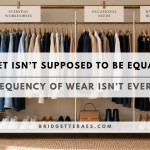
The goal isn’t to make every item in your wardrobe equally useful. The goal is to make the amount you own in each category proportional to how useful that category is to you.
That distinction matters.
YOUR WARDROBE SHOULD BE PROPORTIONAL TO YOUR LIFE
I own a pair of tan pumps. They are an awesome pair from ALLY that were designed for comfort. You can read my review of them here and also find out about an exclusive discount ALLY has extended to our readers.
I probably wear tan pumps once a year. Some years, maybe not even that. If I were following the standard advice that says anything I haven’t worn recently needs to go, those pumps would probably have been shown the door a long time ago. Except they’re incredibly useful.
I don’t wear heels very often anymore, but occasionally I need them. When I do, I have one pair of classic pumps in a versatile tan shade that works with nearly anything I might need to wear them with. I don’t need five pairs of pumps. I don’t need them in black, navy, red, metallic and tan. I don’t need to find more opportunities to wear the pair I own so I can somehow justify keeping them.
I need exactly what I have: one pair of pumps for the occasional times my life requires pumps. Check, done.
The fact that I wear them once a year doesn’t make them a wardrobe mistake. In fact, I’d argue that this category of my wardrobe is almost perfectly calibrated to my life. And that’s a very different way of thinking about wardrobe usefulness.
If you wear jeans four days a week, it may be entirely reasonable for you to own six or eitght pairs of jeans. If you wear a cocktail dress twice a year, you probably don’t need eight or ten cocktail dresses. The numbers themselves aren’t the issue. It’s whether the numbers make sense in relation to your life.
LOW USE ISN’T THE SAME AS LOW VALUE
This is where so much conventional closet-cleaning advice falls apart. “When was the last time you wore it?” can be a useful question, but it can’t be the only question. Some things aren’t supposed to be worn frequently.
You may own a dress that comes out once every couple of years for a formal event. You may have a pair of shoes you primarily wear to weddings. You may have a suit you don’t need for your everyday professional life but occasionally need for an important meeting or presentation. You might even have clothes that exist primarily because sometimes life requires us to dress for things we would rather not have to dress for at all.
A funeral is a perfect example.
Hopefully, you don’t need funeral clothes very often. But when you do need them, that’s a particularly terrible moment to discover that you’ve decluttered your wardrobe so efficiently that you don’t own anything appropriate. There is value in being able to open your closet and know you’re prepared.
Preparedness is a form of usefulness. The dress you haven’t worn in two years might still be doing its job perfectly if its job is to be there for an occasion that only happens every few years.
THE PROBLEM ISN’T UNDERUSE. IT’S OVERREPRESENTATION
Don’t misunderstand me. this doesn’t mean I’m advocating for keeping everything because someday, somehow, somewhere you might need it. Quite the opposite. There’s an enormous difference between being prepared for the occasional realities of your life and maintaining a wardrobe for a hypothetical life you don’t actually live.
If you attend one or two formal events a year, having a few options that you know fit, feel good, and can be styled appropriately makes sense. Having 27 cocktail dresses because someday you might get invited somewhere does not.
This is where I think a better question emerges.
Instead of asking:
“Do I wear this enough?”
Ask:
“How much space should this category occupy in my wardrobe based on how often I actually need it?”
That question changes everything.
Maybe you wear sneakers almost every day and own several pairs. Great.
Maybe you wear pumps once a year and own one pair. Also great.
Maybe you work from home but regularly meet clients virtually, so you need considerably more polished tops than trousers. Your wardrobe should reflect that.
Maybe you travel frequently for work and need several jackets, trousers and shoes that can be mixed and matched easily.
Maybe you attend a lot of charity events, weddings, dinners or professional functions and legitimately need more occasion clothes than someone else does.
There isn’t a correct number of anything. There is only the question of whether the proportions of your wardrobe make sense for the proportions of your life.
YOUR CLOSET HAS TO ACCOUNT FOR THE LIFE YOU LIVE OCCASIONALLY, TOO
One of the unintended consequences of our obsession with wardrobe minimalism and versatility is that we’ve started designing closets almost entirely around what we do most often. Of course, your wardrobe should primarily support your everyday life. That’s where the majority of your clothing budget and closet space should go.
But your everyday life isn’t your entire life. There are things you do weekly, things you do monthly, things you do a few times a year and things that happen rarely but predictably enough that you know they’ll happen again. A functional wardrobe makes room for all of them, in the appropriate proportions. This is also why I don’t particularly like arbitrary rules about getting rid of something because you haven’t worn it in six months, a year or even two years. Context matters.
If you haven’t worn your everyday jeans in two years, that’s probably useful information.
If you haven’t worn your funeral dress in two years, congratulations.
Those two garments cannot be judged by the same standard.
STOP MAKING EVERY GARMENT PROVE ITS WORTH
I think we’ve become unnecessarily punitive about our wardrobes. Everything has to earn its keep. Everything needs a good cost per wear. Everything needs to work multiple ways. Everything should be versatile. Everything should be worn regularly.
But a truly functional wardrobe isn’t one in which every garment works equally hard. It’s one in which you have the right amount of the right things for the life you actually live. Your workhorses should work hard. You should have enough of them that getting dressed every day doesn’t feel repetitive or difficult. Your moderately used categories should be represented moderately. And the things you need rarely should probably exist in smaller numbers, but that doesn’t mean they shouldn’t exist at all.
So the next time you’re standing in front of your closet wondering whether something deserves to stay because you “hardly ever wear it,” don’t stop there. Sure, maybe it needs to go, but…
Ask yourself what job that item is supposed to do. Ask yourself how often that job actually needs doing. Then look at how many other things you own that perform the same function. A pair of pumps worn once a year may be exactly as useful as a pair of jeans worn once a week. You just probably don’t need ten pairs of the pumps.
BEFORE YOU GET RID OF SOMETHING, ASK THESE QUESTIONS
The next time you’re tempted to get rid of something simply because you haven’t worn it recently, take yourself through these questions first:
- What job does this item have in my wardrobe?
Is it an everyday piece, something I wear occasionally, or something intended for a very specific situation? - How often does that situation realistically occur in my life?
Not how often you wish it occurred or think it might occur someday. How often does it actually happen? - When that situation does occur, would I be glad I had this?
If you got an invitation tomorrow, had an important meeting next week, or needed to attend a funeral, would this solve the problem? - Do I own something else that does the same job just as well—or better?
This is where an infrequently worn item can become unnecessary. One pair of rarely worn pumps may make perfect sense. Six pairs serving essentially the same purpose may not. - Is the amount I own in this category proportional to how often I need it?
This may be the most important question of all. If something represents 2% of your life, it probably shouldn’t represent 20% of your wardrobe. - Does it still fit my body, my style and my current life?
Being potentially useful isn’t enough. The item still has to be something you would actually choose if the occasion arose. - If I got rid of this and needed it six months from now, would I have to buy it again?
Sometimes getting rid of a perfectly good occasional-use item only guarantees that you’ll spend money replacing it the next time you need exactly that thing. - Am I keeping this because I’m prepared—or because I’m imagining a life I don’t actually live?
There is a difference between owning appropriate clothes for events you occasionally attend and keeping a wardrobe for the fantasy version of yourself who attends galas every weekend, skis every winter and somehow needs four sequined jumpsuits.
If an item passes those questions, don’t let an arbitrary rule about how recently you’ve worn it convince you that it doesn’t belong.
The goal isn’t to make every item in your wardrobe equally useful. The goal is to make the amount you own in each category proportional to how useful that category is to you.
Your wardrobe doesn’t need to be equally useful. It needs to be proportionally useful.
IS YOUR WARDROBE PROPORTIONAL TO YOUR LIFE?
If you’re looking at your closet and realizing the proportions might be a little off—too much of what you rarely need, not enough of what you actually wear, or gaps that leave you scrambling when certain occasions arise—this is exactly the kind of thing I help my clients figure out.
Personal style isn’t just about finding clothes you like. It’s about building a wardrobe that supports the life you actually live, including the parts of it that only come around occasionally.
If you’re ready to take a more intentional look at what’s working in your wardrobe, what’s missing, and where you may simply have too much of the wrong thing, fill out my complimentary Image & Style Assessment. Tell me a little about yourself, your wardrobe, and where you’re feeling stuck, and we’ll explore how I can help you build a wardrobe that’s truly useful to you.




I really like this concept, and am very tempted to go through my whole wardrobe with this in mind. (Will I? no – unfortunately time does not permit. Might save the activity for a long weekend though…) The “proportional to your life” feels really important – in the last few years I’ve gone from a very sedentary person to someone who needs to wear gym clothes and sports bras on a regular basis during the week. I find my workout wear to be an adequate-sized capsule based on my laundry schedule (weekly laundry, 2x/ week workout, 2x bottoms and 3x tops… for 2 years) but was feeling a little guilty for getting bored with it and wanting to expand a bit. Considering the amount of time spent in those clothes, I may expand a few tops to put into rotation/ swap out for a bit. Thanks for the “permission” to expand.
By the same token, I should cut down on “dresses to wear if I go to a work conference” which apparently happens once every 10 years…
Thoughtful post. I have two sections in my closet: one for easy to pull together and go everyday looks and another section for better outfits when I want to step it up a bit. I have another section tucked in the corner for dressy (but comfortable) party looks. Workout clothes have their own bin. This sounds like I’m terribly well organized. Well, up to a point: still have other clothes that don’t currently fit any of these categories. Need to try them on again and make some choices.
Best article I’ve read in ages….so powerful
Xoxo
Jodie
http://Www.jtouchofstyle.com